← ResearchBenchmark · KDD 2026 Main Conference (CCF-A) · February 2026
SWE-Bench Mobile
Coding agents placed inside a real production iOS engineering workflow reveal a clear capability boundary. Accepted to KDD 2026 — Applied Data Science Track, Main Conference (CCF-A).
SWE-Bench Mobile moves agent-coding evaluation out of open-source GitHub repos and into a real, shipping mobile product. Fifty engineering tasks from Xiaohongshu's production iOS app — each with its original PRD, Figma design, and a hand-written test suite — ask agents to read multi-modal specs and work inside a roughly 500K-line mixed Swift/Objective-C codebase the way a real iOS engineer does.
The results draw a clear capability boundary: even the strongest commercial agent + model combos solve only 12%. And which agent you pick matters as much as which model — same model, different scaffold (the agent framework that drives the model to read code, edit, and run tests), pass rate can swing up to 6×. Much as the same chef cooks differently in a different kitchen — the stove and the workflow matter as much as the craft. The paper is now in KDD 2026's Applied Data Science Track at the main conference (CCF-A).
KDD 2026 · Jeju Island, Korea
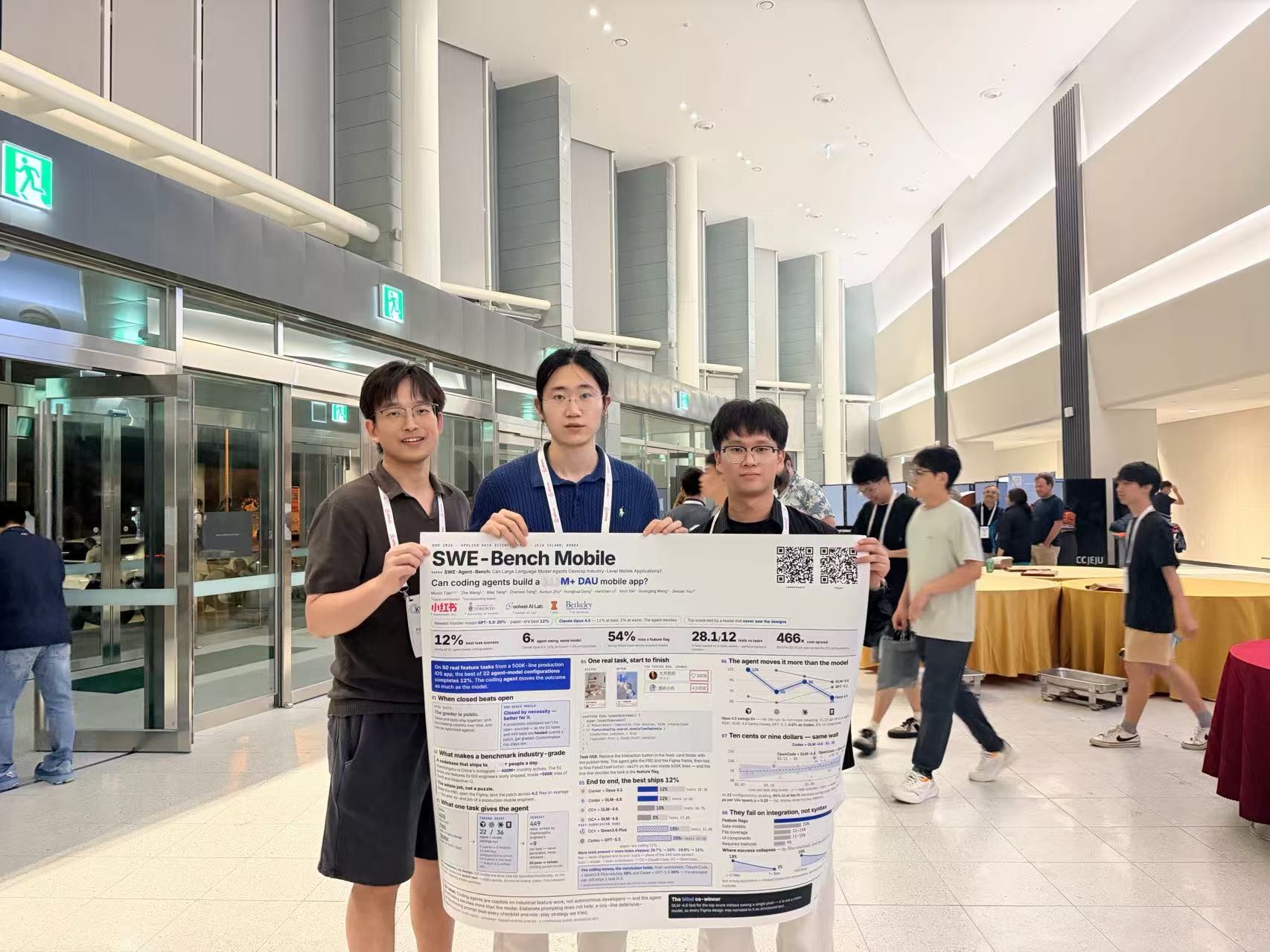
Members of the author team with the SWE-Bench Mobile poster at the KDD 2026 venue.Redrawn from the paper. A real product ticket flows in as a PRD plus Figma plus codebase snapshot; the agent writes a patch; the patch is graded by entrypoint, functionality, and configuration evaluators against a hand-written test suite.
Why we built it
Prior agent-coding benchmarks miss real-world engineering in four ways at once. Open-source repos may leak into pretraining; tasks are bug fixes rather than new features; specs are GitHub issues rather than design documents; and the tests usually already exist. SWE-Bench Mobile reverses all four. The codebase is a real production iOS app, the tasks are feature additions backed by PRDs and Figma designs, and the evaluation harness is hosted-only — keeping test sets out of training data by design.
In one sentence: SWE-Bench Mobile asks whether an agent can understand a real product requirement, read the design, locate the right modules, and land a coherent patch in a production mobile app.
35 tasks include Figma designs; 46 include reference images
Task mix
UI Components 18 · Data Management 10 · Gestures 8 · Media 7 · Networking 4 · Other 3
Task type
feature additions (not bug fixes)
Evaluation
hosted-only (anti-contamination)
Benchmark composition. Task type is the most consequential difference from prior agent benchmarks: feature additions force the agent to build something, not just fix something.
Redrawn from the paper. Task mix. UI components, data management and gesture interactions cover most of the set, with a calibrated easy/medium/hard split.Redrawn from the paper, schematic. A representative task. Each one comes with a before/after screenshot, the Figma reference, and a ground-truth code change — the agent has to produce a diff that survives the test suite.
Results
Twenty-two agent–model configurations were evaluated across four agents (Cursor, Codex, Claude Code, OpenCode) crossed with leading commercial and open models. Top of the leaderboard:
Agent + Model
Tasks solved
Tests passed
Cursor + Claude Opus 4.5
12.0%
28.1%
Cursor + Claude Sonnet 4.5
12.0%
26.7%
Codex + GLM 4.6
12.0%
19.6%
Top of the SWE-Bench Mobile leaderboard. The three leaders are tied at 12% task pass rate but separated by 8.5 pp on tests — a coarse vs. fine-grained capability gap. Live results: swebenchmobile.com.
Redrawn from the paper. Full leaderboard. Twenty-two combos, three tied at the top, a long tail in the low single digits. The ceiling is the headline; the floor is the warning.Redrawn from the paper. Same model, four agents. Opus 4.5 goes from 12% (Cursor) to 2% (OpenCode). The scaffold decides as much of the outcome as the model itself.
What we found
Same model, different agent — up to 6× spread. Scaffolding rivals model choice in importance.
Simple beats elaborate. A "Defensive Programming" prompt outperforms more elaborate prompting strategies by +7.4 pp.
The tests-passed column matters. Tasks that look "failed" at the binary level often pass a meaningful fraction of their tests — useful signal that's invisible if you only track pass@1.
Complex engineering remains hard. Tasks touching 7+ files fall to 2% success, while small localized changes are far easier.
Production deployment practices trip agents up. Common failures include missing feature flags, data models, files, UI components, and required methods.
The same model can vary up to 6× across agents. Reports that name only the LLM are missing half the story.
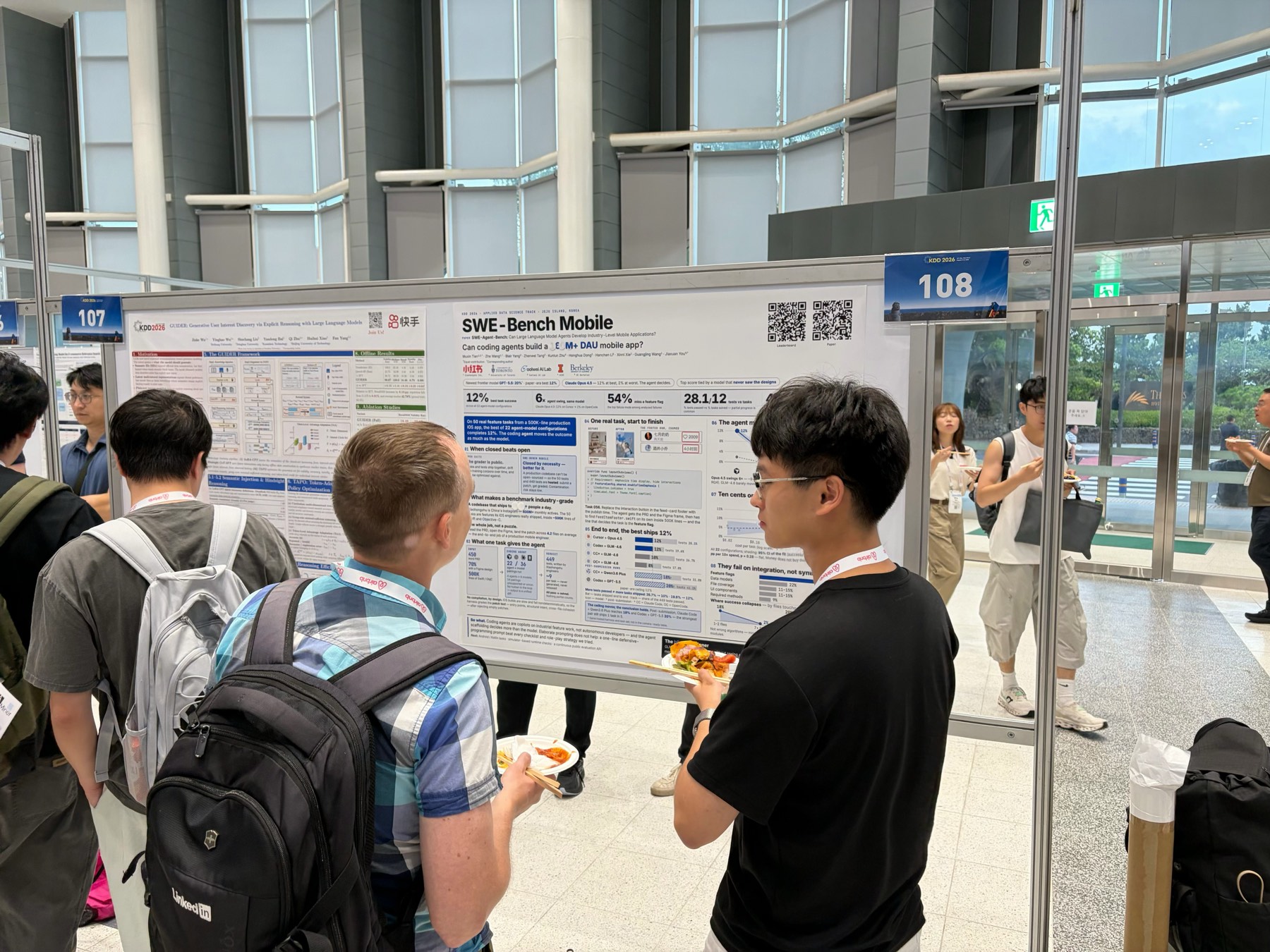
Redrawn from the paper, values approximate. Where success rates drop fastest. The more files or lines a patch has to span, the lower the success rate. Cross-module work is the unsolved part.Redrawn from the paper. Category × agent heatmap. Each agent has its own shape of strength; none is uniformly best, none is uniformly worst.Redrawn from the paper. Stability across reruns. Numbers move between runs, but ordering between agent + model combos stays stable enough to compare.The poster session at KDD 2026. Applied Data Science Track, Main Conference (CCF-A).
Why it matters
First production-grounded agent benchmark.Tasks come from a shipping app, not curated open-source issues. The codebase, the specs (PRD + Figma), and the tests are all real — which means a 12% top score is real, too, and probably overstates rather than understates how much engineering remains for agents to do.
The agent matters, not just the model.A 6× spread on the same model means the field's habit of evaluating "model X" as if the scaffold were transparent is misleading. Agent + model is the unit of comparison.
Hosted-only by design.Submissions run server-side so test sets never leak into training data — a deliberately uncomfortable but contamination-resistant template for industry benchmarks more broadly.
Signal for the field
SWE-Bench Mobile is not a pessimistic result. A 12% strict task success rate shows that today's agents are still far from autonomous mobile engineers; a 28.1% top test-pass rate shows they already do meaningful partial work inside real code. The practical read is sharper: coding agents are useful copilots, but not yet ready to independently own complex mobile feature delivery.
Evaluate on SWE-Bench Mobile
Hosted challenge. Public leaderboard. Submit your agent + model and see where you land on real production iOS work. Paper now in KDD 2026 Main Conference (CCF-A).